On chain games with verifiable ownership and rules
On Quantova, game rules, balances and item ownership are settled by the protocol rather than by a studio server. Players hold their assets directly, developers build against open on chain state, and every transfer is signed with post quantum cryptography.
- ✓Game rules and state are enforced by the network, not by a single operator that can change them.
- ✓Anyone can build mods, agents or new titles against the same on chain data and assets.
- ✓Deterministic finality of about 3 seconds and a typical fee of about five cents, capped at ten cents keep real time play viable.
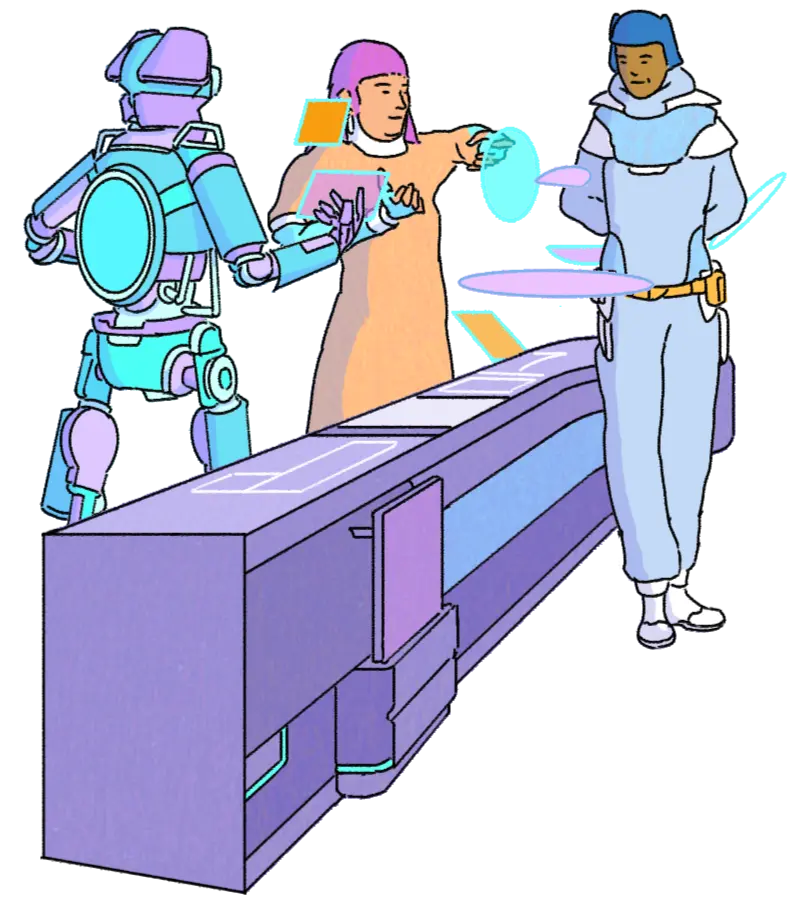
How gaming on Quantova works
Gaming on Quantova spans titles that record specific features on chain and titles whose entire world runs on chain. In every case, the items players hold are protocol assets rather than database entries.
Many titles record in game items as non fungible tokens on Quantova. Players own those items directly and can trade, sell or gift them outside any single studio. The item persists even when the game logic still runs on a central server.
Fully on chain titles place the core mechanics, and often the entire world, inside smart contracts on Quantova. There is no central server and no privileged operator. State transitions are public, the economy is auditable, and the same rules apply to every participant.
Every deployment on the Quantova Virtual Machine inherits post quantum security by default, not by application choice. Studios do not implement signing schemes themselves: every item and transfer is protected at the protocol layer with Falcon, Dilithium and SPHINCS+ signatures and SHA3 256 hashing.
| Property | Detail |
|---|---|
| Item ownership | Held by the player as on chain assets |
| Transferability | Trade, sell or gift across markets |
| Rule enforcement | Smart contracts on the QVM |
| Asset signatures | Falcon, Dilithium, SPHINCS+ |
| Persistence | Assets remain accessible on the network |
Games built on Quantova
Studios on Quantova move past simple reward loops toward deeper, skill driven play, with item ownership recorded on chain.

WAGMI Defense
Hold your base against waves of attackers. Each unit and defence is an on chain asset you can upgrade, trade or sell, and player versus player matches set the leaderboard.

Illuvium
An open world role playing title with an arena mode, built to a high production standard on Unreal Engine. Item ownership and the in game economy settle on chain.

Gods Unchained
A free to play trading card game in which players own their cards as on chain assets and compete in strategic matches for rewards.
Play to earn with real ownership
Play to earn titles let players hold in game assets that carry value beyond the game. Mature designs reward skill and contribution rather than relying on token emissions that cannot be sustained.
- ✓Players hold in game currency and items as on chain assets they can trade or sell.
- ✓Strategy and skill drive rewards, in place of reward schemes that erode over time.
- ✓Settlement is final in about 3 seconds, so earned value clears quickly and predictably.
Interoperability and cross chain play
Traditional games lock items and progress inside a single title. On Quantova, items and game logic can interact across applications and chains, with the same protocol level security applied throughout.
Assets composed on Quantova are open. A studio can build a new title against items minted by another, and a marketplace can list assets from many games at once. Composability turns each item into a building block rather than a closed record.
The Quantova bridge extends this reach across 36 blockchains and 78 assets held on the QVM. Cross chain legs are validated by on chain light clients for Ethereum and BSC, proven outward with zero knowledge proofs, and post quantum signed for Bitcoin, Tron and Solana.
| Property | Detail |
|---|---|
| Item model | Composable on chain assets |
| Reach | 36 blockchains, 78 assets |
| Light client legs | Ethereum, BSC |
| Outward proofs | Zero knowledge |
| Signed legs | Bitcoin, Tron, Solana |
Throughput and predictable fees
Quantova runs interactive play at a cost players can predict. Hybrid Deterministic Consensus delivers finality in about 3 seconds, and the transaction fee is about five cents, capped at ten cents regardless of network demand.
Start playing on Quantova
Two steps put you in front of any on chain title. Set up a post quantum wallet, fund it with QTOV, and connect.
Set up QMask
QMask holds your assets and signs every action on the device with NIST approved algorithms. Set one up to interact with on chain titles.
Fund with QTOV
Acquire QTOV to cover the capped transaction fee and to take part in the on chain economies of the titles you play.
Connect and play
Connect your wallet to a title and your items move with you. Every transfer is post quantum signed and settled by the protocol.
Build games on post quantum rails
Set up a wallet to play, or build a title where item ownership and rules are settled by the protocol.
Owned by Quantova Inc. Released under the Business Source License 1.1.